bookmark_borderBelow The Root: Exploring Topside

Hours Played: 6

The Wiki entry for Below The Root suggests that the game was created to correct an “error” that the author introduced to her works. That “error” seems to be that the main character of the books was killed.

Upon receiving multiple letters from adults and children alike who’d read the works, she saw a way for the game to continue the sequence of events started in the books – and even – to build a new little bit of plot on top of it.

In that sense, Below The Root is both fascinating for what it’s trying to achieve as much as it is interesting to play.

It’s very rare that a game will continue a book [or movie’s plot] and so so in such a very authentic way, but I think that it helps that the author was on board for this particular creation. She helped flesh out the place the player would spend time in, and she made sure that the plot of the game was consistent with what had been before.

The nature of the plot was something I’d guessed at, but wasn’t sure about when I started playing, but now that I’m six hours in [hours that I’ve mostly spent exploring], I’ve come across two direct affirmations that largely cemented my suspicions.

My travels above ground have also yielded some interesting mechanical details that – again – the manual just doesn’t mention. [But these are non-surface level details that you’d have to learn by playing the game – the manual can’t pin down EVERYTHING you can and cannot do. That would be non-nonsensical.]

Chief among these mechanical details is the fact that every character starts off in their own Nid-place – their home. Each home has items in it that can be picked up. Fruits and tokens and Shubas [more on those in a moment] and the like.

The mechanical wrinkle is fairly simple: If I start with Neric and I travel to Genaa’s Nid-place, I DO NOT get access to her items, even though she’s not in her home and even though those might be useful to me.

The mores of Green-Sky are prevalent even here: if it’s not yours, you can’t take it unless it is offered to you. I genuinely like this.

I like it, because it subverts years and years of “training” in games that suggests that if something isn’t nailed down, you can just yoink it.

But I also like it, because it re-enforces one of the central axioms of this particular game, and that is: be kind.

As for the Shuba – these are flying-squirrel-like capes that the characters can don, so that they can get around the world a little faster. They do this by gliding from one branch of a tree to another.

I haven’t spent a lot of time using one, mainly because I’ve been trying to trek everywhere on foot at least once, so that I know where I can and cannot go.

My to-do list has grown since I posted last, to whit, I have to:

  • raise my spirit stat in the garden. [I’ve found the garden. I’m not sure what I have to do.]
  • search the heights of Grand Grund. [I’ve done this and we’ll talk about it a little in the next post.]
  • get underground. [I know EXACTLY how to do this, but I’m trying to be methodical in my explorations. My next plan is to actually get this done.

And that’s it for right now.

As the game would say:

Peace and joy to all questers!
bookmark_borderBelow the Root: Upstairs at Neric’s

Hours played: 3

Below the Root is an old-style open-world game in the best tradition. [Think of the early Ultimas, for example.] – it’s “in the best tradition” because there’s no towers to climb and no map markers to swat and there aren’t only a handful of activities to do.

Instead, it’s the kind of open-world game where you have to find out what’s going on and you do that by exploring. As you explore, you find tools to deal with the challenges the world presents you – which – in turns – opens you up to more exploring.

We’d commonly call this a Metroidvania, but here, it’s just a very surprising design for a game from 1984.

On first boot, I try playing the game in the composite mode thinking that the colours might be nicer. And it’s true, they are: it’s much better than looking the original CGA palette, but text in the composite mode has never been the best, and I fear this is going to cause long-term eye strain. Maybe in my next session, I’ll just settle for plain old CGA.

After my first few hours playing the game, I learn a handful of lessons, some of which are a little surprising. Some of which aren’t. It really IS a game from 1984. There’s no guide for how to do things yet, so the developers made it up as they went along.

The first serious thing that I learn pertains to movement, which is a little odd. This is the before-times. There’s no assuming it’s WASD. Or, in fact, that it’ll work like you expect it to. Instead, once I press the key for going in a specific direction, the character just KEEPS going in that direction. My keyboard has two sets of directional keys – the number pad and the arrow keys and, at first, I try and control Neric – my chosen character – with the arrow keys. This goes terribly. Every time I send him off in a direction, hitting that same key makes him attempt a jump. This ends up costing stamina, because he jumps into walls and that hurts.

The next thing I learn is something I didn’t talk about when we were discussing the manual: it clearly says I have 50 days to do my task – finding out whatever I can. I hate this. There are no words to describe how much I dislike timers in games. “Oh sure!” Lots of you might argue, “timers are great for tension!” No. No they’re not. They just induce a subtle sort of panic. This specific panic, in me, particularly, is about optimization: am I playing the game in the most efficient way, and let me tell you friends, NO GAME should make anyone feel like this. After all, games are supposed to be fun.

I make lots of little pleasant discoveries, too, one of which is quite interesting for a game this old: facing matters. If I try and talk to someone and I’m not close to them and looking at them, the game just asks “speak to whom?” When I try. This shows great attention to detail. I like this a LOT.

Maybe the most amusing thing I find out in this session – and in short order, too, is that doors don’t always go where I expect: a door that looked like the left hand of a building took me to the RIGHT side of that same place when I went inside. I like this less.

Apart from this, my three hour session really amounts to mapping the place and documenting little things the manual doesn’t tell you. It never explains, for example that you can only climb UP vines. Or, for that matter that swimming is bad and you die when you try. [But the “death” message is hilarious.] or that each player character has their own sprite [neat!]

One very cool thing about the game – and a thing which very much gives away the sentiment of the books [I should think] and the character of the people working on this game is that while other people’s stuff IS fair game, you do have to request those things by speaking to the people who own the items first. Trying to grab something that’s nailed down but not yours just results in the game not giving you that item. Cordiality – and friendliness – go a LONG way in this world. Which is something you can see in almost all of the characters that spend their single line or two of speech talking to you.

I can’t tell you how much I love this. It’s so kind and gentle. It’s absolutely refreshing to see in a game.

As of right now, I have a handful of “objectives.”:

  • Raise spirit in the garden.
  • Find the temple key to open the gates [which gets me to the right side of the map.]
  • Get to a point where I can Kiniport items. I’ve seen at least two that I can grab if I can just get my spirit meter high enough.

Welcome to the game, folks. I hope you’re going to enjoy it as much as I am!

bookmark_borderBelow the Root: The Quest Begins

I’ve never encountered Below the Root in the wild. Some of this has to do with the fact that neither the Apple II or the Commodore were very big, here, but a lot more of it has to do with the fact that computers and computer gaming have had a slightly different trajectory where I live and so, this game just flew under the radar.

I first encountered it on the web at about the point where Abandonware started becoming a prominent facet of video game archival, but I’ve never sat down to play it, before now.

Instead, it’s taken almost twenty five years for me to decide, “now’s the time to try this,” and what’s eventually nudged me over the edge was The Trickster’s posts along with an interesting take on the game that’s cemented my interest.

I tend to like games that try things, and here’s a game that doesn’t want you to commit violence at all. I’m all for that.

To get going, I’ve done exactly as the manual suggests: I’ve watched the introduction and the sample quest to get an idea of what I’m in for.

The problem is that the sample quest [a recording of someone else’s game play] seems a TINY bit spoilery, but ah. It’s too late now.

Now, though, I have to make a handful of choices. The first of these is which version I should play. As noted in the title card, there are several releases of the game for different systems. It’s difficult, now, to trace which version is the original [though I strongly suspect it’s likely the Commodore 64 one], but they’re each interesting in their own way. So let’s discuss that first:

  • The Apple II version has bleeps and bloops that sound a little like the PC version, but boasts some nice colours. This looks a bit like the composite CGA IBM version and so I think they’re mostly comparable, but…the Apple II version also wants me to disk swap. Annnd hard pass on that.
  • The PC version should just be a booter. That is: I would power down my machine, stick the disk in the drive, power on the machine and wait. The version of DOS on the game disk would boot and take me directly to the game. While that’s convenient, and there’s no disk swapping, I also get the WORST looking colours of the lot if I plump for just-CGA. Composite RGB in CGA mode gives me nicer colours but worse text. [And since this is in the era of PC-speaker music, I absolutely get the worst music of the bunch.]
  • The Commodore 64 version has OK colours, but it too requires disk swaps. However, the music is [not surprisingly] leagues better than the what I was hearing on either of the other two machines.

In the end, I decide on the PC version. Mainly because someone’s written a version that doesn’t need you to boot into it that also has slightly enhanced save game capabilities.

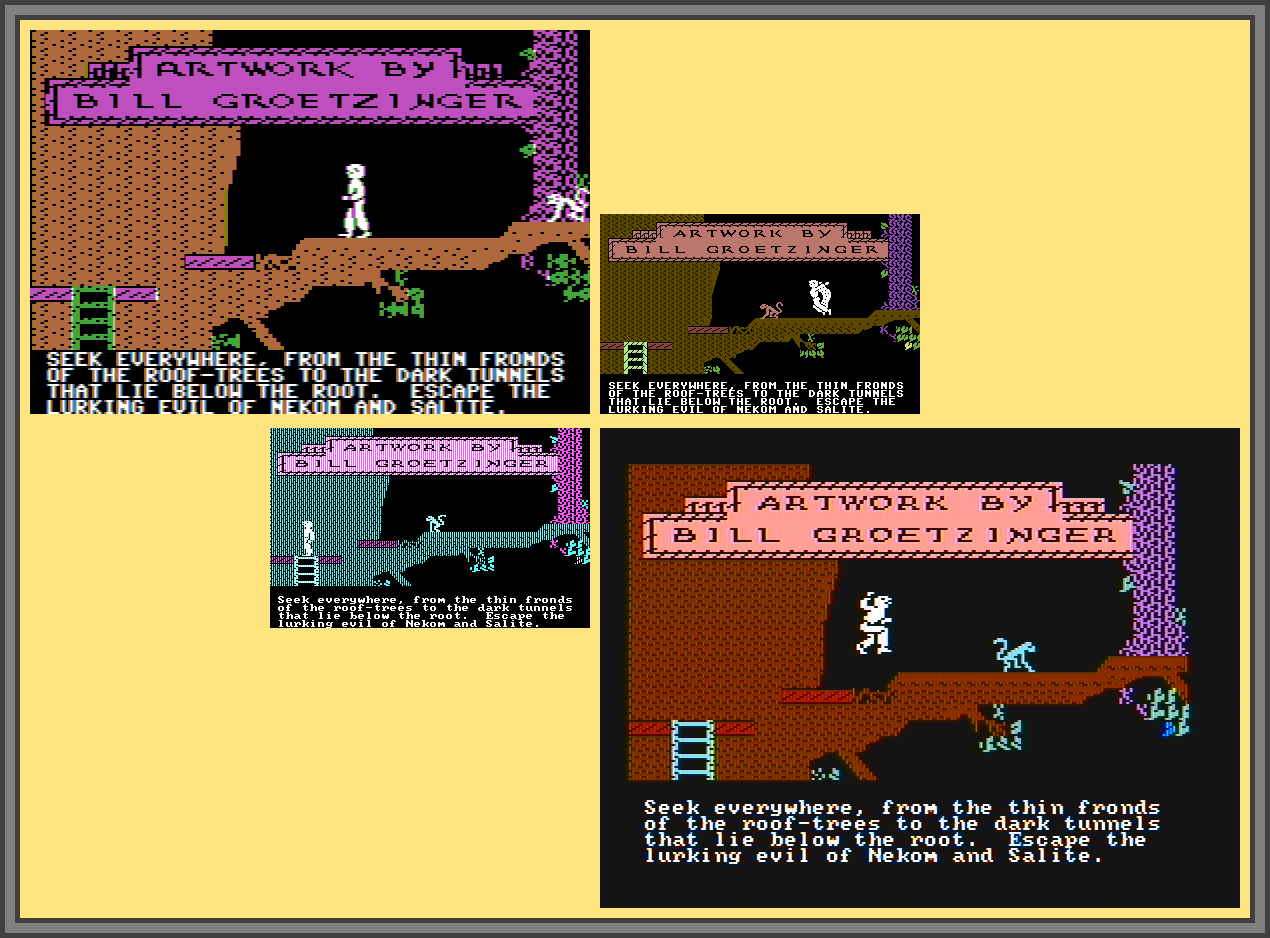
There are three versions of Below the Root I could play. In this image, I show off one screen from each, noting the differences in colour. In each screenshot, the player is controlling a character that's walking along a tree. To the left of them is a ladder that they can climb. A few lines of text proclaim that this is a game with artwork by Bill Groetzinger. There's also a little bit of introductory text that reads: "Seek everywhere, from the thin fronds of the roof-trees to the dark tunnles that lie below the root. Escape the lurking evil of Nekom and Salite." In SOME versions of the screenshot, there's also a little monkey-like creature peeking in from the right hand side of the screen.
From top-left to bottom-right: Apple II, Commodore 64, PC booter [with plain CGA] and PC booter [showing off the composite CGA mode. Nicer colours, worse text.]

The next major decision is choosing my Quester

Your quester is [unsurprisingly] the person you’ll be playing throughout the game. They have a small number of scores [mostly to do with stamina and psychic abilities] and they hail from different parts of the game world, which affects where you start out.

These are:

  • Neric: Neric starts near the Star Grund, which the manual tells me isn’t very far away from the shops. His starting stats are: Spirit Limit: 5; Stamina 20
  • Genaa: Genaa starts in the Grand Grund and has NO spirit skill at all. So: Spirit Limit: 0; Stamina 20
  • Pomma: She starts out in Sky-Grund. Her stats are: Spirit Limit: 10; Stamina: 10
  • Charn: The manual goes out of it’s way to note that Charn “can pense emotions but not messages.” I’m not sure what that means. Either way, he starts out in the Silk Grund. His stats are: Spirit Limit: 5, Stamina 15.
  • Herd: Herd lives in Broad Grund, though he started off life “below the root.” Like Charn, he “can pense emotions but not messages.” The manual also mentions that he’s “very rational.” His stat line is: Spirit Limit: 5; Stamina: 20.

A few odd things to note: the first three characters are all Kindar – one of the races in the game. The manual also mentions that Pomma is Raamo’s sister – my understanding of this is that Raamo was the main character in the books, and thus, you’d be “continuing the thread of the books” if you were to play them. [Which makes sense. The internet suggests that one of the reasons the game came to be at all was to retcon the ending of the final Green-Sky book.] The same is also true of Neric, who was evidently Raamo’s friend and companion throughout the Green-Sky trilogy. The final couple of characters are both Erdlings.

From what little I’ve read [because I’ve never read the books], it seems to me that the Kindar and Erdling were once the same race, but something happened and they split apart. With this split, the one half of the race developed psychic powers [pensing], while the other sort of did, but also kind of didn’t.

I also find it interesting that in choosing your character, you’re choosing your difficulty. I will intentionally be choosing Neric to start, but I’m hoping that once I understand the game a little bit better, I’ll swap over to Genaa for the full experience.

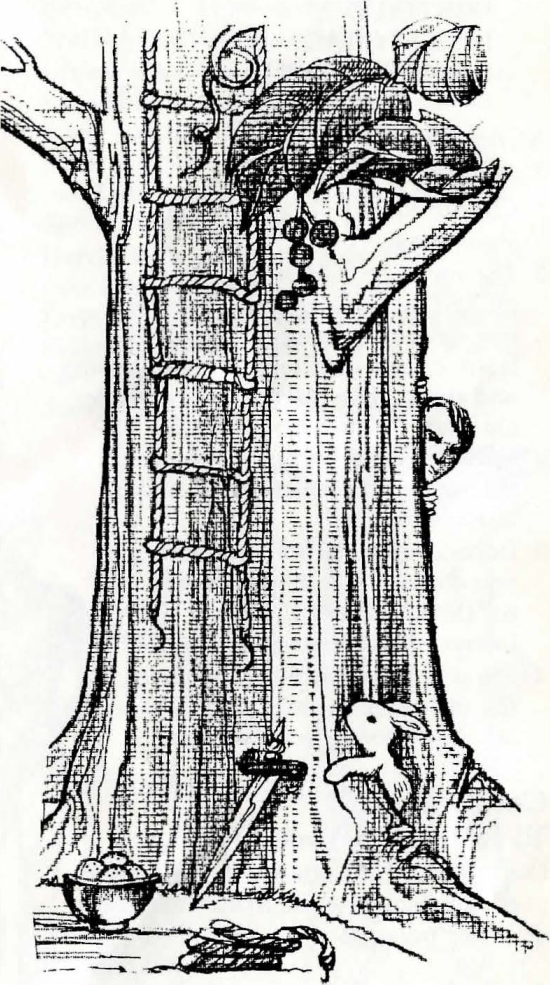
This is a picture from the manual depicting a fairly bucolic and woodsy scene with a ladder stretching from on high down to some tools on the ground. A little rabbit peeks in from the right, possibly wondering what the Kindar or Erdling is up to.
This is fantastically bucolic. The manual is full of little whimsically, woodsy drawings like this.

In the next post, we’ll talk about some actual game play!

bookmark_borderGame 1: Below The Root: Box And Tangible Items

Game: Below The Root
Developers: Dale Disharoon, Zilpha Keatley Snyder
Publisher: Spinnaker Software/Windham Classics
Publication Date: 1984
Platforms: Apple II, Commodore 64, IBM PC
Genre: Adventure
Hours Played: 0
Referring Blog: The Adventurer’s Guild Posts: 1, 2, 3, Won!, Rating

One of the great pleasures of the early years in gaming was window shopping.

You’d go to a store and look at all the cool boxes on the shelves, because – back then – it was difficult to find information about games, so sometimes, you just bought a game sight unseen, because of the artwork that upfronted the package, or because of the screenshots on the back of the game.

You wouldn’t even necessarily be going to a computer game store, because those didn’t exist, yet.

My very first memory of actually buying a game, in fact, is from 1988 when I walked into – what was then – a furniture store. They had a little section where you could browse boxes and I very often did [but that’s a story for another time, because we’re not playing that game.]

So the act of buying a game was pretty visceral.

Of course, once you got that box back home, you’d be in for another treat, because games in the 1980’s lived on a sliding scale of opulence.

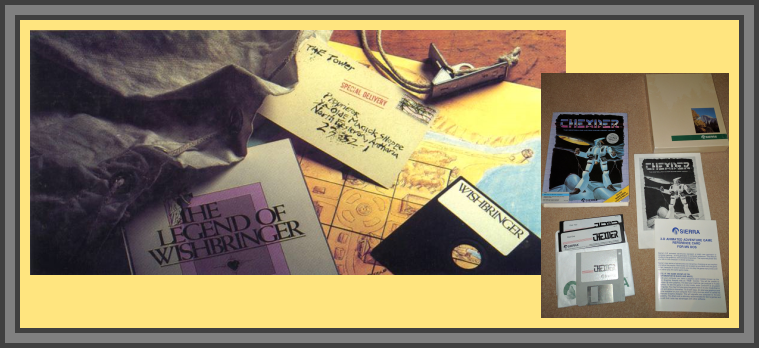
On the one hand, you had Infocom, king of the “feelie,” a term that came to be synonymous with the little bits that the game maker thought to put inside the box to draw you into their world, because very often, those worlds were rendered in primitive bitmaps or “crude” text. No fancypants realistic graphics for us.

On the other, well, you had basically every other game company who thought just far enough to put a disk in the box and some instructions for playing the game, as well as, perhaps, a short set of instructions for running it. [and if it was a casette, you’d literally JUST get the little fold out with instructions that was big enough to fit inside that case.]

An image showing a (doctored by Infocom) set of "feelies" - out-of-game items that were there to make you feel "connected" to the game that came in the box. In the case of Wishbringer - the game on display here, you get the Wishbringer itself (a stone), a map, an envelope containing a clue, a manual and a disk. Compare that with Thexder, also depicted here. You literally just got /just/ the game, the disk and the manual.
You know, given how much extra STUFF is in Wishbringer, I’d rather play that, thanks!

Below the Root lay somewhere in the middle.

On the one hand, you have the pretty opulent Commodore 64 box with it’s fold out that told you a little bit about the game and the world.

Seriously, check this out:

The INCREDIBLY opulent [for the time] fold-out cover of Below The Root for the Commodore 64. Here we have an outer flap which leads to an inner gate-fold that has game images and descriptive text telling you a little about the game.
Windham/Spinnaker never did this again, I don’t believe, but it’s majestic.

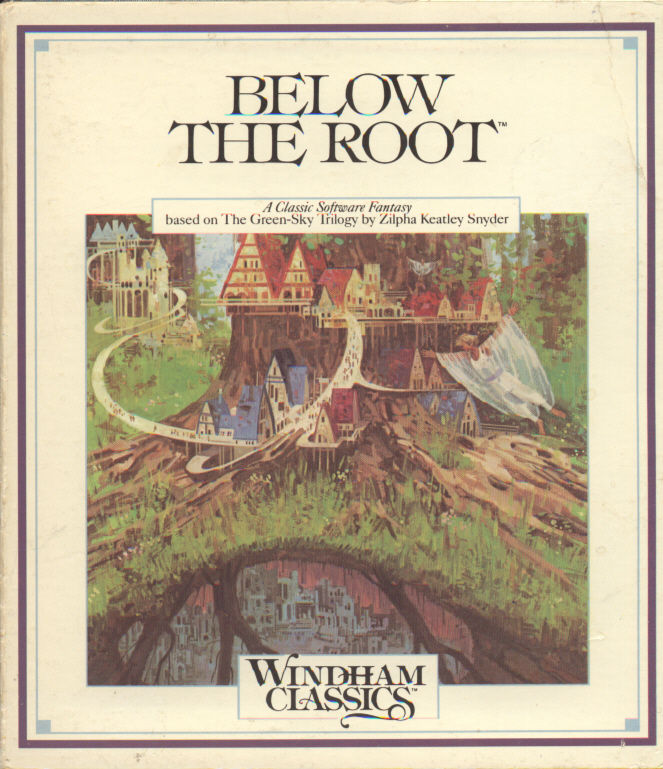
I love how evocative this box art is – right from the old-timey feel of the box itself to the actual picture depicting a little bit of Green-Sky. It’s incredibly evocative and a MUCH more interesting image than the so-prevalent SEMI-SHAVEN MAN-DUDE WITH GUN.

There’s hints of what we might see and learn, here: the world is divided into two planes – an above and a below. The above is pretty colourful, hinting at a sort of false utopia, perhaps, while the below is dark and pretty dingy.

And the flying person is neat. It suggests the game’s likely primary mode of travel.

There’s so much good, here.

I’m not sure why we don’t do this anymore.

[Well, I know, and much of it has to do with focus testing, anyhow, onward!]

On the other…well…they didn’t want to make SPECIFIC instructions for each port of the game, so they just bundled them all into a game manual that told you what to do regardless of which version you were playing.

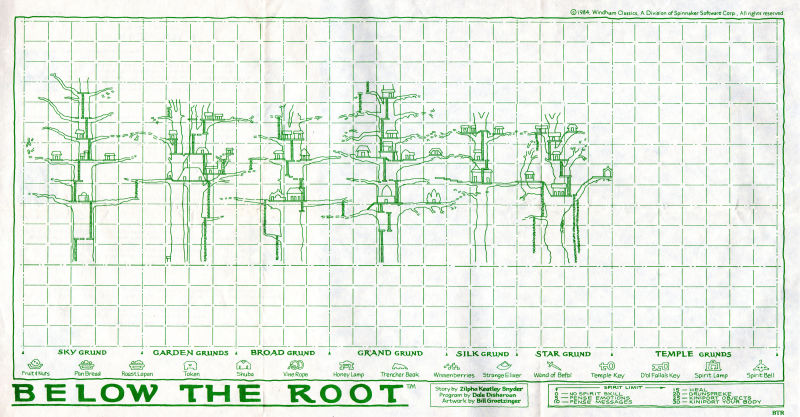
Along with that, you got a map – it’s difficult to tell just from looking at it, if the map is complete. There seem to be squares surrounding what’s drawn here that suggest I might need to add more. That’s daunting. I’m not a terribly good artist.

The map for Below the Root. It's divided into two main segments: the actual map itself, blocked out into squares that you can annotate, and a legend below that with a list of interesting items you might find in the game world.
I’m not an artist, oh God!

And, of course, you got the disk.

Up next! I decide which version of the game to play and we have a closer look at the manual.


Image Attributions:

Wishbringer feelies via The Infocom Gallery

Thexder Box and items via Pix’s Origin Adventures

Below the Root map and box via Mobygames

bookmark_borderLostwolfe: An Introduction.

Hello, and welcome to The Infinite Playlist.

I’m your host Lostwolfe and together, we will be playing games played by other people on different blogs around the internet.

My History With Games

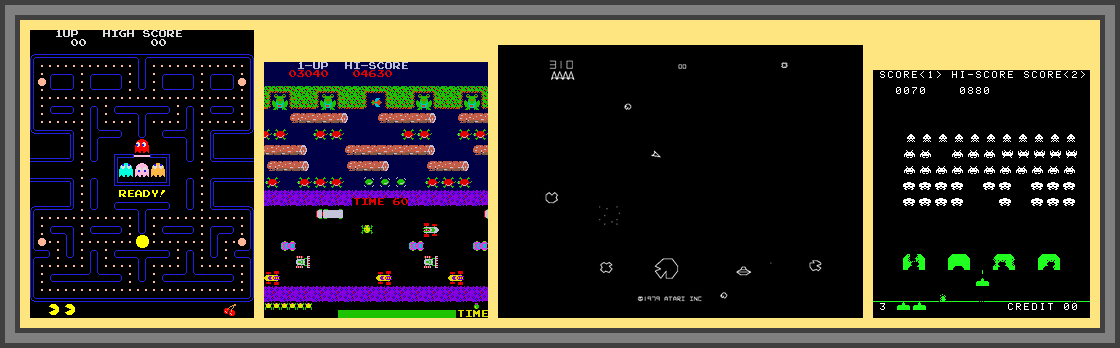
I started playing video games in the very early 80’s. The very first few games I ever encountered in the wild were Pac-Man, Frogger, Asteroids and Space Invaders.

Most of these were in arcades or little corner stores, where for a little while and a couple of cents, I could lose myself in the rhythmic shuffle of the invaders, or I could outsmart Pinky and the gang, or I could have the zen experience of trying to dodge asteroids.

An image depicting some of the very earliest video games I ever played. From left to right: Pac-Man, a game about eating pellets and ghosts, Frogger, a game about crossing a road - as a frog, Asteroids, a game about surviving in space in an asteroid field and Space Invaders, a game where you were earth's last hope, repelling invaders...from space!
I have fond memories of playing all of these.

In the long run, though, none of these games held a lasting appeal for me. My hand-eye co-ordination was never really great to begin with and these games were very much just testing those skills.

What I didn’t know I wanted was an actual COMPUTER game.

I didn’t know that I was looking for a kind of game that was slower and that didn’t so much depend on me hitting the fire button at the right time while I was in the right place for things to work out.

This notion of a slower game only ocurred to me one summer in 1986, when I visited a friend and they showed me both King’s Quest III and Space Quest I.

An image showing a pair of old Sierra games. The top half of the image is devoted to King's Quest 3, in it, the hero Gwydion is walking down a treacherous pathway to a valley where he might find items to aid his quest. In the bottom half of the image, we have Roger Wilco, the protagonist of Space Quest, battling against a Spider Droid [which explodes on impact] and an Orat, a strange, rather violent creature that lives on the planet Kerona.
Tread carefully!

After that, all bets were off. I had an old machine that was in the process of dying [my trustworthy, but ill-fated Spectravideo computer] and I traded that in for a regular old PC.

That PC was solid as a rock and lasted me almost right until 1991, where I had to buy a whole new machine.

During that time, I finally got my hands on and played Space Quest I and King’s Quest III, which then opened other vistas: The Secret of Monkey Island, occasional dalliances with the Gold Box games. An aborted attempt [with a bad disk] at playing Hunt for Red October.

I’ll readily admit that none of these games /looked/ as good the games in the arcades at the time, and I desperately wanted some developer to create something is beautiful as Toki, but in the end, my patience won out.

This is a screenshot of the game Toki, in which a man gets turned into an ape and must save his girlfriend from the clutches of evil. It's a proto-typical [though very difficult] platformer. Here, Toki must ascend a vine and shoot a mid-level boss to proceed.
A VERY difficult platformer, but look at that beautiful pixel art.

VGA and Soundblaster both ushered in something of a golden age of gaming and I was there for it.

But times change. At this late juncture, I can no longer enjoy the AAA half of the industry. It’s too greedy, too cynical and too mired in Live Service nonsense for me to give it much of my time.

So, I have branched off into indie games, but also back tracking some, to where things all started. Which leads us to here.

The Infinite Playlist

As of late, I’ve been reading blogs by other people and been thinking about back tracking – playing – and sometimes re-playing – old games for pleasure and documenting the act.

At first, I wasn’t sure how to tackle this idea, but then I hit on two concepts I really liked. One was the written Let’s Play and the other was appreciating other people’s accounts of their time with these older games.

I figured I could do a little bit of both of these things.

So, this blog will be devoted to:

  • highlighting other blogs that have covered these games
  • playing them through for my own enjoyment.

First up, we’re going to tackle Below The Root.

This is the cover of Below The Root, for the PC. The picture depicts the land of Green-Sky which exists on two planes: an upper plain, which is beautiful and serene and a lower plane, which looks dour and frightening. There is also a person floating down from on high to the little village depicted above-ground.
This is so evocative. I wish we still got interesting covers like this.