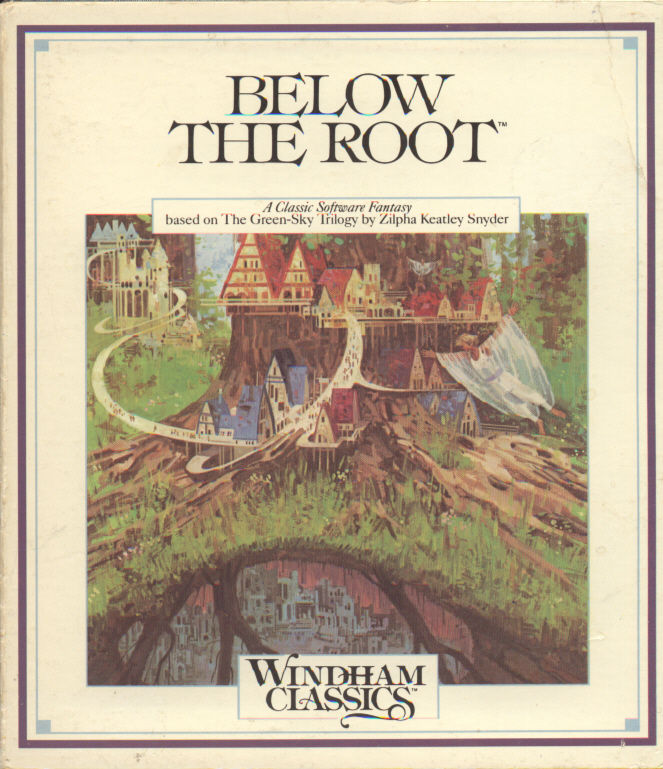
Hours Played: 6
The Wiki entry for Below The Root suggests that the game was created to correct an “error” that the author introduced to her works. That “error” seems to be that the main character of the books was killed.
Upon receiving multiple letters from adults and children alike who’d read the works, she saw a way for the game to continue the sequence of events started in the books – and even – to build a new little bit of plot on top of it.
In that sense, Below The Root is both fascinating for what it’s trying to achieve as much as it is interesting to play.
It’s very rare that a game will continue a book [or movie’s plot] and so so in such a very authentic way, but I think that it helps that the author was on board for this particular creation. She helped flesh out the place the player would spend time in, and she made sure that the plot of the game was consistent with what had been before.
The nature of the plot was something I’d guessed at, but wasn’t sure about when I started playing, but now that I’m six hours in [hours that I’ve mostly spent exploring], I’ve come across two direct affirmations that largely cemented my suspicions.
My travels above ground have also yielded some interesting mechanical details that – again – the manual just doesn’t mention. [But these are non-surface level details that you’d have to learn by playing the game – the manual can’t pin down EVERYTHING you can and cannot do. That would be non-nonsensical.]
Chief among these mechanical details is the fact that every character starts off in their own Nid-place – their home. Each home has items in it that can be picked up. Fruits and tokens and Shubas [more on those in a moment] and the like.
The mechanical wrinkle is fairly simple: If I start with Neric and I travel to Genaa’s Nid-place, I DO NOT get access to her items, even though she’s not in her home and even though those might be useful to me.
The mores of Green-Sky are prevalent even here: if it’s not yours, you can’t take it unless it is offered to you. I genuinely like this.
I like it, because it subverts years and years of “training” in games that suggests that if something isn’t nailed down, you can just yoink it.
But I also like it, because it re-enforces one of the central axioms of this particular game, and that is: be kind.
As for the Shuba – these are flying-squirrel-like capes that the characters can don, so that they can get around the world a little faster. They do this by gliding from one branch of a tree to another.
I haven’t spent a lot of time using one, mainly because I’ve been trying to trek everywhere on foot at least once, so that I know where I can and cannot go.
My to-do list has grown since I posted last, to whit, I have to:
- raise my spirit stat in the garden. [I’ve found the garden. I’m not sure what I have to do.]
- search the heights of Grand Grund. [I’ve done this and we’ll talk about it a little in the next post.]
- get underground. [I know EXACTLY how to do this, but I’m trying to be methodical in my explorations. My next plan is to actually get this done.
And that’s it for right now.
As the game would say:
Peace and joy to all questers!
![An image showing a pair of old Sierra games. The top half of the image is devoted to King's Quest 3, in it, the hero Gwydion is walking down a treacherous pathway to a valley where he might find items to aid his quest. In the bottom half of the image, we have Roger Wilco, the protagonist of Space Quest, battling against a Spider Droid [which explodes on impact] and an Orat, a strange, rather violent creature that lives on the planet Kerona.](https://lostwolfeslair.com/TIP/wp-content/uploads/2022/10/01_02_sierra_games.png)
![This is a screenshot of the game Toki, in which a man gets turned into an ape and must save his girlfriend from the clutches of evil. It's a proto-typical [though very difficult] platformer. Here, Toki must ascend a vine and shoot a mid-level boss to proceed.](https://lostwolfeslair.com/TIP/wp-content/uploads/2022/10/01_03_toki.png)